
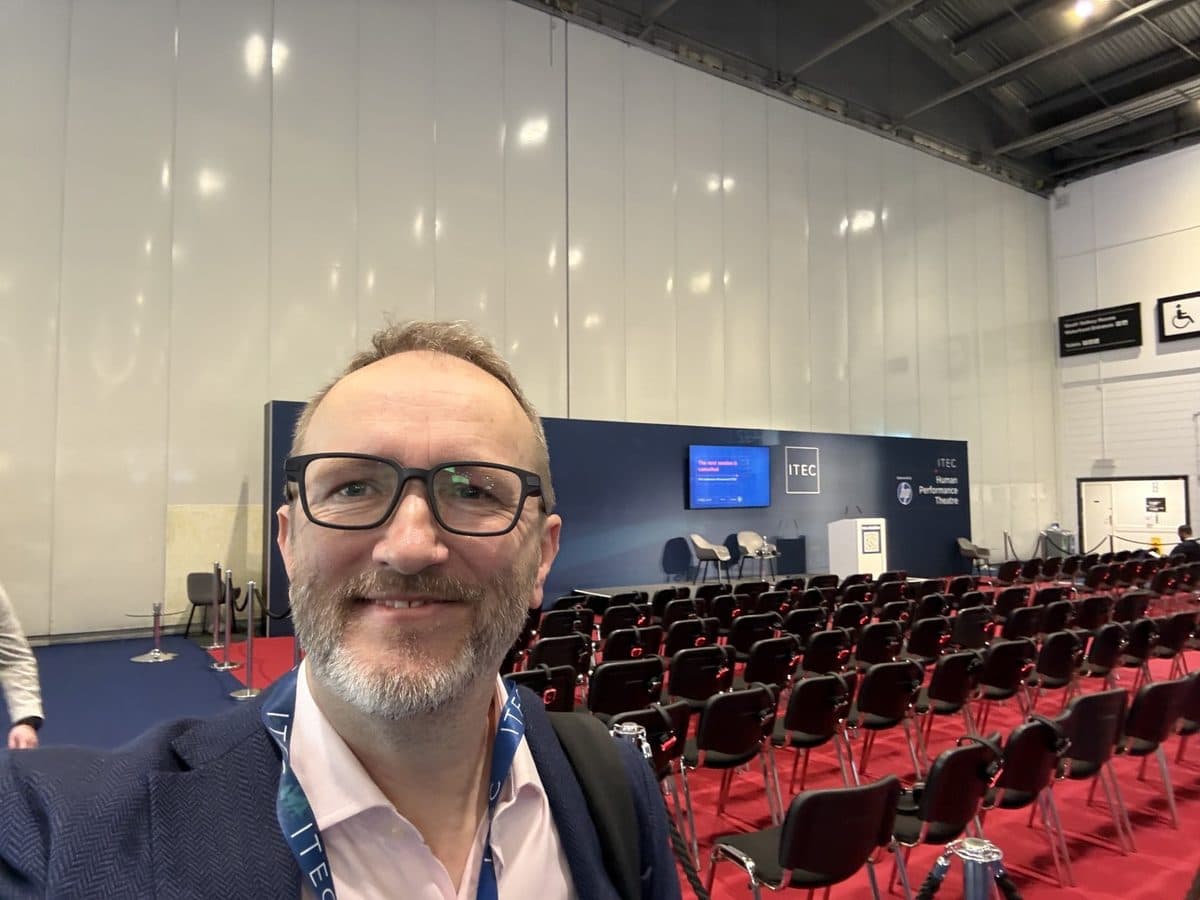
I presented Feel to know: Using emotion to measure real understandingin the Human Performance Theatre at ITEC 2026 — Europe’s largest defence training and simulation conference. The talk argued that completion rates and post-training assessments are measuring the wrong thing at the wrong time, and that emotional AI can close that gap.
I came away with more than I expected. Not just validation, but a clearer sense of where the genuine need sits — and where the market is moving.
There is a lot happening in this space
The volume of AI activity in defence training and adaptive learning was striking. Multiple vendors, multiple approaches, real investment. The category is not nascent — it is actively being built out. That is useful context for where EchoDepth sits: the market does not need to be convinced that AI belongs in training environments. The question is which signal AI should be working from.
Most of what I saw was working from behavioural proxies — time on content, click patterns, quiz performance. These are post-hoc and downstream. They tell you what happened after understanding was required. EchoDepth works upstream, at the moment of stimulus exposure, before any test has been taken or answer submitted.
Predicting content needs before the learner asks
A thread that ran through multiple sessions was adaptive learning — using AI to predict what content an individual needs next. This is the right direction. But the adaptation in most systems is reactive: a wrong answer triggers a different content path. The learner has already failed before the system responds.
The more interesting possibility is adapting before the fail — detecting confusion, hesitation or cognitive overload in real time during content exposure, and redirecting before the learner has surfaced a gap themselves. That is what measuring emotional state during training makes possible. The signal is there. It just has not been captured before.
“Completion is not the same as understanding.”
A line that came up repeatedly across sessions at ITEC 2026 — and the core argument behind EchoDepth’s application to training.
This was the line that resonated most clearly in the room. Every training professional present knew it. The question they have not yet had a good answer to is: if completion is not the signal we want, what is? Emotional state during the training itself is that signal. The FACS-based measurement EchoDepth uses captures the involuntary physiological response — confidence, hesitation, confusion — at the moment of stimulus exposure, 200–500 milliseconds before any verbal response forms.
Neurodiversity changes the picture significantly
The neurodiversity dimension was raised more than once, and it matters more than the mainstream adaptive learning conversation currently acknowledges. Happy sheets and self-report measures are weakest precisely where you most need them to be reliable. Neurodivergent learners are more likely to mask, less likely to accurately self-report confidence, and more likely to demonstrate a wide gap between stated understanding and actual comprehension.
EchoDepth’s approach sidesteps the self-report problem entirely. The measurement is involuntary — it does not ask the learner to evaluate their own understanding. That makes it structurally better for neurodivergent populations, not as an accessibility feature, but as a more accurate baseline for everyone.
No other solution in the defence training space I saw at ITEC was making this claim credibly. That is a specific, defensible position — and one worth developing further.
What this means for EchoDepth
ITEC confirmed that the problem EchoDepth addresses is real and is being actively discussed by people who commission and run defence training programmes. It also confirmed that no current solution is measuring understanding during training — only behaviours and outcomes after it.
The market does not need educating about AI in training. It needs a reason to believe that a different class of signal — emotional state, not behavioural proxy — produces meaningfully better outcomes. That is the case we are making, and the reception at ITEC suggested it lands.
Talk to us
If you were at ITEC — or if this resonates with a training challenge you have — we would like to hear from you.